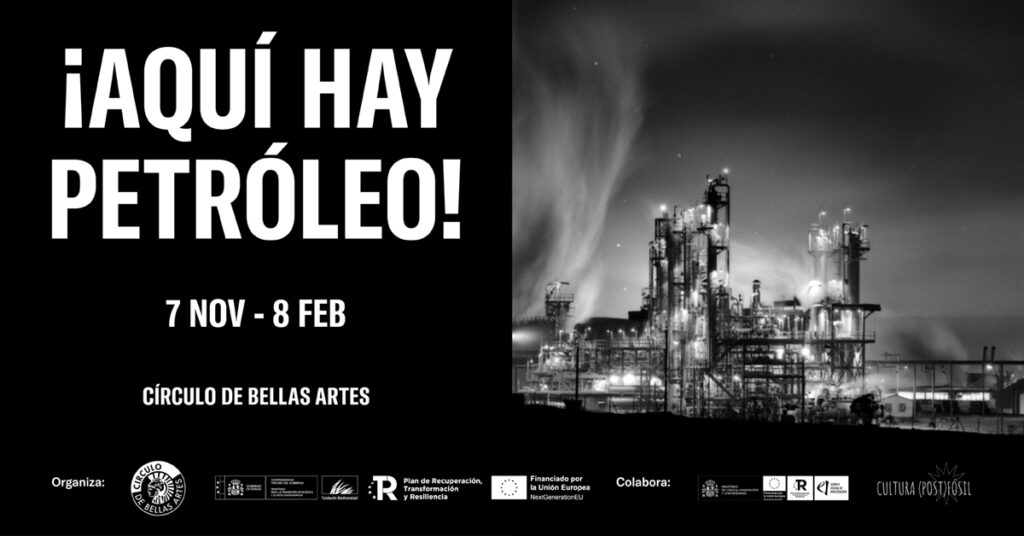
¡Aquí hay petróleo!

This exhibition explores the relationships between fossil fuels, contemporary forms of power, and the imaginaries of desire. It focuses on the cultural history of fossil modernity in Spain and, in particular, during Francoism, tracing a genealogical line that connects past and present.
The dictatorship promoted several oil prospecting initiatives aimed at guaranteeing the country’s energy sovereignty during the autarkic period, while simultaneously fostering international cooperation to reduce the regime’s isolation. As a satire of this fossil anxiety, Rafael J. Salvia’s film ¡Aquí hay petróleo! (1955), which gives the exhibition its title, depicted how the hopes of finding oil were ultimately disappointed in the Castilian town of Castilviejo.
Through numerous images from various state and private archives, the exhibition shows how the dictatorship generated a set of cultural imaginaries intended to ward off and overcome the perception of backwardness in its attempt to join the accelerated rhythms of industrial modernity. After the failure of its colonial projects, the avant-garde aesthetics of energy infrastructures and industries fulfilled a redemptive role in the history of Francoism. They were seen as capable of closing the gap between the alleged greatness of the national spirit and the scarcity of natural resources required by modernization policies. These infrastructures established a link between energy and well-being that, while never forgetting the legitimacy of the regime´s origin, projected it toward a future that would leave behind the trauma of the Spanish Civil War.
¡Aquí hay petróleo! proposes a fundamental idea: fossil modernity is not merely an industrial policy program. It is also a source for the production of collective imaginaries. The curatorial narrative incorporates the reflections of researcher Cara Daggett, who has defined the relationship between masculine subjectivity and the use of fossil fuels through the concept of “petromasculinity.” One of its origins lies in the fascist exaltation of war culture and the cult of the leader during the interwar period. Francoism reproduced these imaginaries around the crusade of the civil war and around the tractor as a symbol of economic autarky. Later, with the rise of developmentalist policies, the private automobile became the focal point for expectations of happiness and freedom associated with the idea of progress, while reinforcing patriarchal structures.
Updating this historical matrix, the exhibition illustrates how these worldviews constitute the subjective substrate upon which contemporary petromasculine cultures are reconstructed, drawing on new formats such as digital imagery, social media, and video games. This occurs at a time when the fossil world shaped after World War II is being shaken by the threat of climate change, the urgency of an accelerated energy transition, antifeminist backlash, and the emergence of sadistic, fascist, and genocidal global leaders.
Image credits: Calatrava. Calvo Sotelo Complex in Puertollano [General view. Night] Juan Miguel Pando Barrero, February 1971. Pando Archive, Spanish Cultural Heritage Institute, IPCE, Ministry of Culture and Sports, MCD