[embedyt] https://www.youtube.com/watch?v=sCrrhD35UPM[/embedyt]
The Dream of Water Produces Monsters
Enlightenment, Hydraulic Capitalism, and Imaginaries of Power in Contemporary Spain
? 4 September 2025
? 4:30 PM (CEST)
? Aula Magna Silvio Trentin
? Event Overview
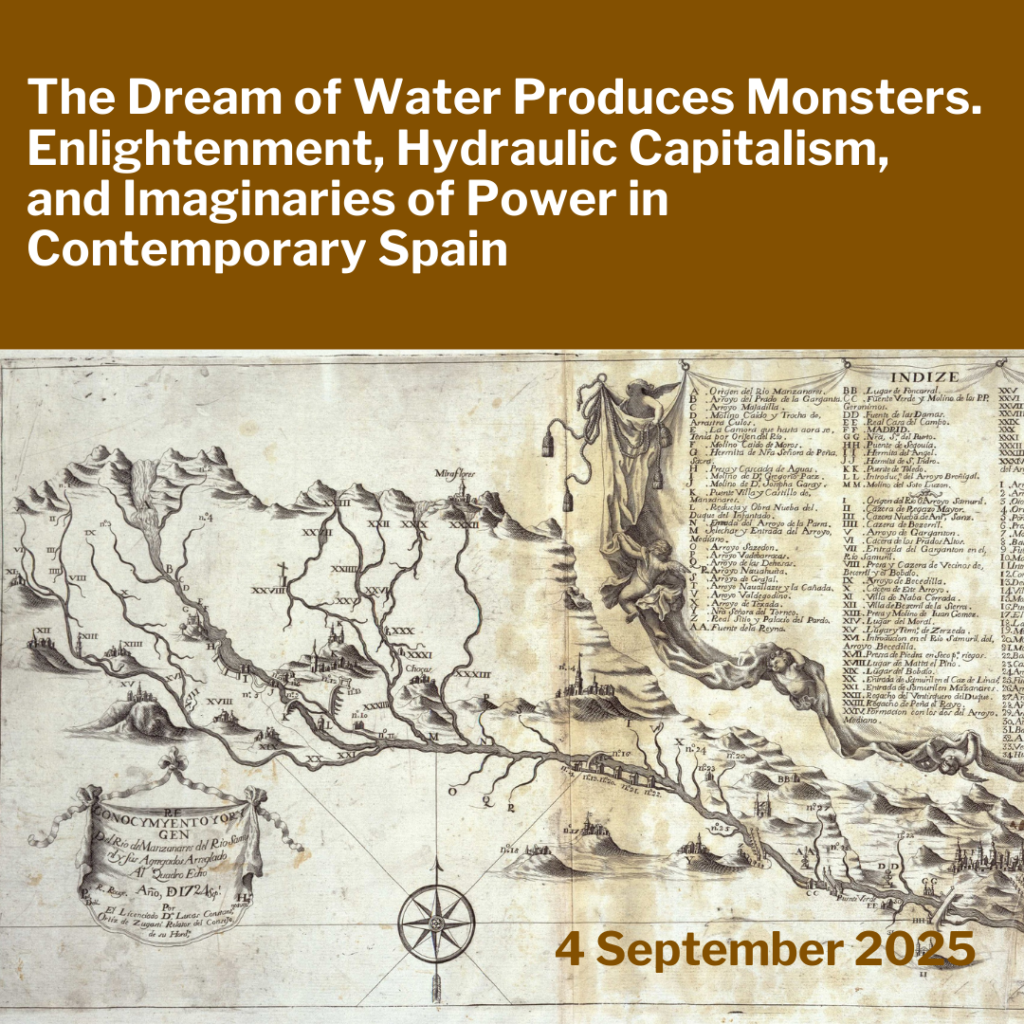
This presentation examines the historical relationship between processes of modernization and water imaginaries in contemporary Spain, drawing on a comparative framework informed by Italian environmental history. Taking the modern history of the Manzanares River (Madrid) as a case study, the talk traces how water has functioned not only as a material resource, but as a political, economic, and symbolic axis of power.
Through a genealogical approach, the presentation explores how different regimes of thought, governance, and infrastructure have shaped hydraulic policies and imaginaries, revealing water as a key site where Enlightenment rationality, capitalist expansion, authoritarian planning, and contemporary ecological contestation intersect.
? Structure of the Presentation
The analysis unfolds across four historical moments:
1. Enlightenment Court Projects (18th Century)
The first section addresses the hydraulic projects of court Enlightenment, which promoted a decentralized model of industrialization. These initiatives encouraged the establishment of small factories along artificial canal networks, the expansion of irrigated agriculture, and the repopulation of inland Spain.
2. Liberal Industrial Modernization (Early 19th Century)
The second moment focuses on the liberal modernization processes of the first half of the 19th century, marked by land privatization through expropriation laws. These policies sought to impose the logic of political economy on natural resources, often in tension with the persistence of feudal social relations.
3. Regeneracionismo and Imaginaries of Nature (Late 19th–Early 20th Century)
The third section explores the imaginaries of nature articulated by Regeneracionismo, which advocated the full exploitation of national water reserves. Public works—such as small hydroelectric plants, conceived as more efficient and economical than fossil energy—were envisioned as drivers for producing a new nature, a new geography, and even a new climate.
4. Francoism and Large-Scale Hydraulic Infrastructure
Finally, the presentation examines how Francoism reinterpreted earlier hydraulic imaginaries through the construction of large reservoirs. Initially embedded in autarkic policies and later aligned with economic liberalization, this approach followed a form of “political ecology” of water closely connected to Italian fascist policies and the postwar miracolo economico.
? From Hydraulic Power to a New Water Culture
The talk concludes by addressing contemporary proposals for a “new water culture”, emerging from social and environmental movements opposing the socio-environmental impacts of energy infrastructures. These debates continue to shape—both positively and negatively—current discussions around renewable energy transitions, territorial justice, and ecological sustainability.
? Speaker
Jaime Vindel
European PhD in Art History
Master’s Degree in Philosophy and Social Sciences
Tenured Scientist, Department of Art History and Heritage
Institute of History, Spanish National Research Council (CSIC)