Understanding our time means recognizing the centrality of environmental issues, with the aim of fostering a debate that allows us both to act in the present and to adopt a historical perspective. From the standpoint of ecological and energy humanities, it’s essential to ask about the links between colonialism, authoritarianism, and fossil fuels in the context of the techno-political development of modern states and global capital.
What relationships exist between the different forms of modern power and the energy regimes of industrial modernity? To what extent are the so-called energy alternatives to fossil modernity driving the transformations needed to confront the ecological emergency?
This seminar—coordinated by Adrián Almazán (Universidad Carlos III de Madrid), Alberto Berzosa (Universidad Autónoma de Madrid), Julia Ramírez (Universidad Complutense de Madrid), and Jaime Vindel (CSIC)—stems from the collaboration between Museo Reina Sofía, the Ecological and Technological Humanities research group at UC3M, and the CSIC’s Energy Humanities project: “Energy and Sociocultural Imaginaries between the Industrial Revolution and the Eco-Social Crisis.”
Program
Wednesday, January 24, 2024 • 17:00–20:00
Session 1: Ontological Debates for a Crisis Present (Eco-social)
— Facilitator: Adrián Almazán
The concept of nature has historically been used—and legitimated with scientific arguments—to justify gender inequality, class differences, the destructive impacts of capitalist economic growth, and colonial imperialism. But does that mean we should abandon the idea of “nature”? Is the notion of natural difference inevitably tied to inequality or domination? This session tackles these questions within the context of the global eco-social crisis.
At one end of the spectrum are ecofeminists like Carolyn Merchant and philosophers like Jorge Riechmann, who argue that the problem isn’t “nature” itself, but the modern cultural construction of it as an inert, mechanistic object that can be dominated. At the other end are thinkers such as Donna Haraway and Jussi Parikka (and, more broadly, new-materialist theorists), who assert that the problem lies ontologically, in attempting to draw a strict boundary between nature and culture or technology. They advocate for hybrid ontologies (cyborgs, techno-natures, etc.), in which the concept of “nature” loses its hierarchical power.
Participants will divide into four groups to work on one of the assigned texts. Each group will begin the session by presenting a brief summary of the main arguments, addressing questions such as: Does the text defend the concept of “nature”? How does it define it? After these presentations, the session will continue with an expert lecture and conclude with a group debate centered on two key questions:
-
Do we need “nature” in order to halt the global eco-social crisis?
-
If yes, what kind of “nature” do we mean?
Wednesday, February 14, 2024 • 17:00–20:00
Session 2: Ecotopias, Memories and Specters
— Facilitators: Alberto Berzosa & Julia Ramírez‑Blanco
This session examines the intersection of “archive” and “ecotopia,” drawing on audiovisual creations from various Spanish environmental archives and artistic production since the 19th century. Although the term “ecotopia” gained popularity with Ernst Callenbach’s 1975 novel, it became a broader concept describing imagined or desired societies in harmony with nature. Here, “archive” is understood as a cultural-political device for preserving materials and knowledge, as well as a field of tension between domination and resistance—what Kevin McSorley calls “structures of enmity.” Archives also serve as creative platforms for reimagining history and projecting utopian futures.
Inspired by Aby Warburg’s Atlas Mnemosyne, the session is hybrid: facilitators provide guidelines, and participants collectively build a constellation of proposed images—alongside additional visuals generated through discussion—highlighting the persistence of utopian and eco-political imaginaries in the society-nature relationship. Preparatory materials and session guidelines will be shared with participants in advance.
Key Readings:
-
Ariella Azoulay, Historia potencial y otros ensayos (2014)
-
Alberto Berzosa, Materiales para una utopía ecologista (2023)
-
Ernest Callenbach, Ecotopía (2020)
-
Kevin McSorley, “Archives of enmity and martial epistolology” (2021)
-
Julia Ramírez‑Blanco, Amigos, disfraces y comunas (2022); Habitar el horizonte … (2023); “Ecotopías militantes” (2023)
Wednesday, March 6, 2024 • 17:00–20:00
Session 3: Possible Futures & the Eco-Social Emergency
— Facilitators: Adrián Almazán & Jaime Vindel
Focusing on short- and mid-term social actions and political strategies, this session explores how to direct contemporary ecological concerns toward post-capitalist, post-growth, and post-Anthropocene futures. While scientific diagnoses of the ecological crisis can provoke awareness or mobilize eco-political action, they can also reinforce political paralysis, consumer individualism, and dystopian narratives that limit imagination. The session highlights current eco-social transition projects including Green New Deal proponents, degrowth advocates, eco-socialist class- and race-based proposals, and half-Earth socialist visions emphasizing planetary rewildering, regenerative agriculture, and wildlife protection.
Key Readings:
-
Max Ajl, A People’s Green New Deal (2021)
-
Alyssa Battistoni et al., A Planet to Win (2019)
-
Luis González Reyes & Adrián Almazán, Decrecimiento: del qué al cómo (2023)
-
Jason Hickel, Menos es más (2023);
-
Matthew T. Huber, Climate Change as Class War (2022);
-
Other manifestos and theoretical texts.
Wednesday, April 3, 2024 • 17:00–20:00
Session 4: Ecofeminisms—Centering the Politics of Care
— Guest: Carmen Madorrán Ayerra
— Facilitators: Julia Ramírez‑Blanco & Jaime Vindel
Dedicated to exploring intersections of ecology and feminism within the eco-social emergency, this session navigates a spectrum from essentialist ecofeminism—claiming a natural affinity between women and Earth—to constructivist theories that frame gender roles in care and reproduction as socially defined. Often rooted in activism and movements, ecofeminism has generated diverse aesthetic expressions in ecological art. It centers social reproduction, concrete work, and the planet’s biophysical limits as key elements in reorganizing society’s metabolic and symbolic systems. This perspective also connects to ecological economics and economic democracy. Key questions include: what does it mean to center life-sustaining practices? How do human needs theories inform this?
Key Reading:
-
Carmen Madorrán, “Cuatro distinciones para pensar las necesidades hoy,” PASAJES no. 66 (2022)
Monday, June 17, 2024 • 19:00–21:00
Session 5 (Public): The (Im)possible Energy Transition
— Guest: Jean‑Baptiste Fressoz
— Facilitator: Adrián Almazán
Science and environmental historian Jean-Baptiste Fressoz joins Adrián Almazán to reflect on recent global energy changes and critique existing eco-transition models. Fressoz argues that despite two centuries of “energy transitions,” the world still burns more oil, gas, and biomass than ever. Rather than thinking in terms of transitions and substitutions, he urges we consider energy symbiosis and accumulation.
While there’s broad agreement on phasing out fossil fuels and adopting decarbonized alternatives, Fressoz challenges whether “transition” is itself a misleading concept.
Tuesday, June 18, 2024 • 17:00–20:45
Sessions 6 & 7 (Public): Eco-Environmental Perspectives in Iberian Cultural Studies
— Featuring: Jaume Franquesa & Iñaki Prádanos; Moderators: Almazán, Labrador & Vindel
17:00–18:45 — Iberian Cultural Studies & Eco-Ecologies moderated by Germán Labrador & Jaime Vindel
Iñaki Prádanos discusses his book A Companion to Spanish Environmental Cultural Studies (2023), considering cultural production through ecological dimensions—energy, resources, ecosystems, multispecies interdependence—and their role in forging critical historical understandings of imperial and extractivist pasts.
19:00–20:45 — Ecological Transition or Expropriation? Encounter with Jaume Franquesa moderated by Adrián Almazán
Focusing on Franquesa’s Molinos y gigantes (2023), this session uses ethnography from a region in southern Tarragona to analyze how nuclear and renewable energy projects impact rural economies and moral landscapes. Discussions will address continuity in extractivism, internal colonialism in renewables, the anthropological lens in energy studies, and how rural moral economy insights might inform alternative energy transitions.
Wednesday, July 3, 2024 • 20:00–22:00
Session 8 (Public): Ecologies of Utopian Desire
— Featuring: Miguel Brieva with Alberto Berzosa & Julia Ramírez‑Blanco
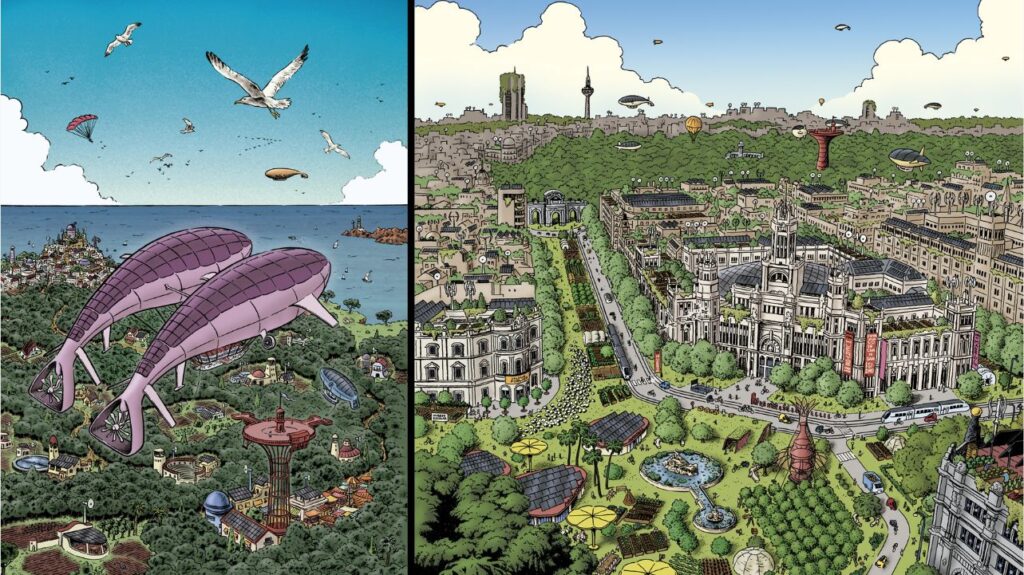
Ecologies of Utopian Desire features cartoonist and writer Miguel Brieva—renowned for his ecological imaginations of desirable worlds—in conversation with Alberto Berzosa and Julia Ramírez‑Blanco. They reflect on utopia as “education of desire” (a concept by philosopher Miguel Abensour), considering the political agency of collective dreams, their viability, and ideological underpinnings, aligned with the session’s theme of “ecotopias.”